MAIN ARTICLE
Different measures answer different questions
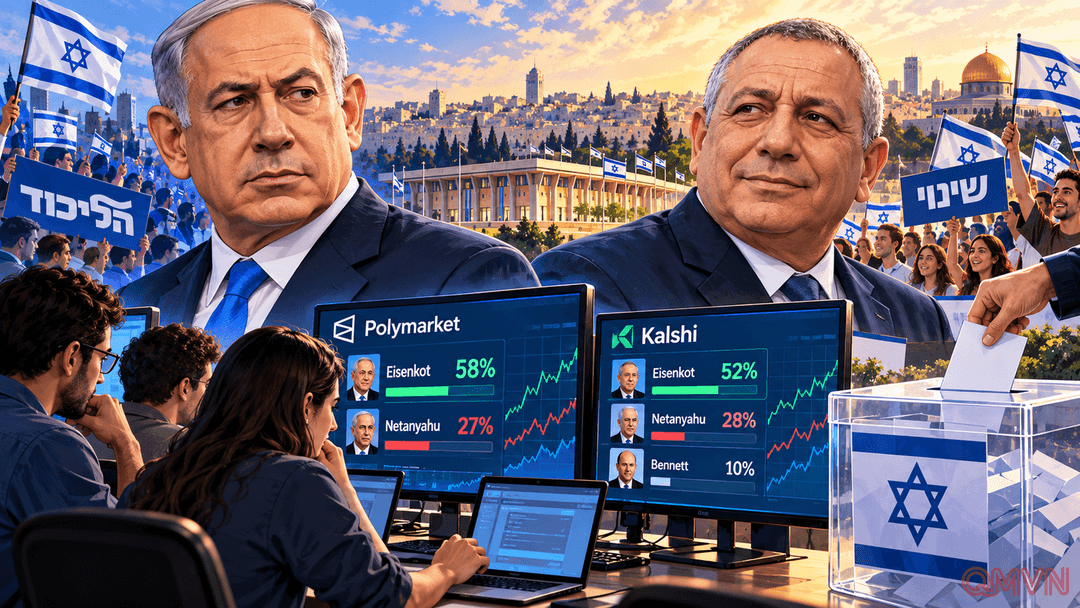
In an October 26 briefing, Kalshi put Eisenkot’s implied chance of becoming the next prime minister at about 52%, compared with 26% for Netanyahu and 10% for former prime minister Naftali Bennett. These figures are market prices translated into implied chances, not voter approval ratings. Prices move with trades and liquidity; Polymarket figures reported by media outlets similarly favor Eisenkot, though exact readings differ depending on when they are checked.
A polling compilation tracked by the Middle East Forum instead assigned 53 seats to Netanyahu’s bloc, 53 to opposition parties and 14 to Arab parties, based on seven surveys available before election day. None of those figures constitutes an automatic 61-seat coalition. A party that wins the largest number of seats might still lack sufficient partners to govern, while a different combination might ultimately assemble a working majority.
Israelis vote for party lists, not directly for a prime minister. Government leadership emerges through negotiations among parties after the votes have been counted. A contract asking who will be sworn in consequently measures a different outcome from a poll measuring party preferences. Both can be informative, provided readers resist the temptation to treat them as interchangeable forecasts.
Concentrated money and the limits of crowd wisdom
A study titled “Who Sets the Odds on Israel’s Election?”, published on October 20 by Joshua Mitts, Moran Ofir and Dan Zimmerman, reconstructed trading activity in election-related and regional conflict markets. The researchers reported $64.3 million wagered on Israel’s election and Netanyahu’s political future across 89,212 accounts.
Those substantial totals do not mean every participant carries equal weight in setting prices.
The researchers found that more accounts favored Netanyahu while larger sums were positioned against him. They also traced overlap between election traders and participants in markets tied to war involving Israel and Iran. Large, early or unusual wagers warrant scrutiny, they argued, while expressly warning that an account classified as a candidate for informed trading should not be treated as proof of access to inside information.
Polling organizations design samples to represent voters; prediction markets attract a self-selected population willing to commit money. Financial incentives can reward accurate judgments, but concentrated positions can also move a relatively thin market. If a sudden price change becomes a widely repeated headline without disclosure of the trading structure behind it, the appearance of broad public agreement may be misleading.
The decisions that follow the ballot
Eisenkot’s advantage in trading prices therefore signals expectations among market participants, not an electoral victory. Netanyahu’s failure to command a clear majority in polls likewise does not eliminate his path back to office. Coalition negotiations, the bargaining power of smaller parties and shifts between blocs may prove decisive once official results become available.
The stakes extend beyond political personalities. As Associated Press explained in its October 27 election overview, voters face unresolved arguments over security responsibility following the October 7, 2023 attack, exemptions from military service for ultra-Orthodox men, regional wars and Israel’s international relationships. These disputes shape both voting choices and the concessions potential coalition partners may demand.
For readers, the most useful question is often the simplest: does a figure describe projected seats, a traded probability or a potential governing arrangement? Vote totals and the subsequent coalition process will gradually settle what the betting market can only price in advance. Elections confer representation; governing requires alliances that can survive beyond election night.
Subscribe to the QMVN newsletter
A daily morning digest - only stories worth reading, no spam.