The Passing of a Pioneer
In its statement, MIT, where Hamilton worked from 1959 to the mid-1970s, called her a "computing pioneer." Professor Olivier de Weck, interim head of MIT's Department of Aeronautics and Astronautics, stressed her extraordinary stature.
"To say Margaret Hamilton was a pioneer – to say she was ahead of her time – would be a dramatic understatement." — Olivier de Weck
According to de Weck, she was a software engineer when the field was in its infancy, and she not only wrote advanced code herself but also led a team in building one of the most complex systems humanity had ever achieved. On X, NASA Administrator Jared Isaacman described her as a pioneer whose work helped make Apollo and humanity's first journeys to the Moon possible.
From Mathematics Student to Apollo's First Programmer
Born in Indiana in 1936, Hamilton studied mathematics before moving to Boston, Massachusetts, with her husband in 1959. She worked at MIT in meteorology and, in 1965, joined a lab looking for people to develop software to "send a man to the Moon." Highlights of her career include:
- She was the first programmer, and the first female programmer, on the Apollo project at MIT.
- By 1968, she was assistant director in charge of the command and service module software team, with more than 400 people working on Apollo's software.
- She published more than 130 papers and founded the software companies Higher Order Software and Hamilton Technologies.
- She was awarded the Presidential Medal of Freedom by President Barack Obama in 2016.
From a mathematician, she became one of the architects who laid the foundations of modern software technology.
"There Was No Second Chance"
The software developed by Hamilton's team had to meet near-absolute standards of reliability. During the historic Apollo 11 flight in 1969, when the guidance computer became overloaded just before landing, a design that allowed the system to prioritise the most critical tasks helped the crew continue to a safe landing.
"There was no second chance. We knew that." — Margaret Hamilton
Speaking to MIT News in 2009, she recalled that many team members began the journey while still in their 20s and saw coming up with solutions and new ideas as an adventure. Because software was then a mysterious "black box," upper management gave them total freedom and trust.
The Legacy of a Pioneer
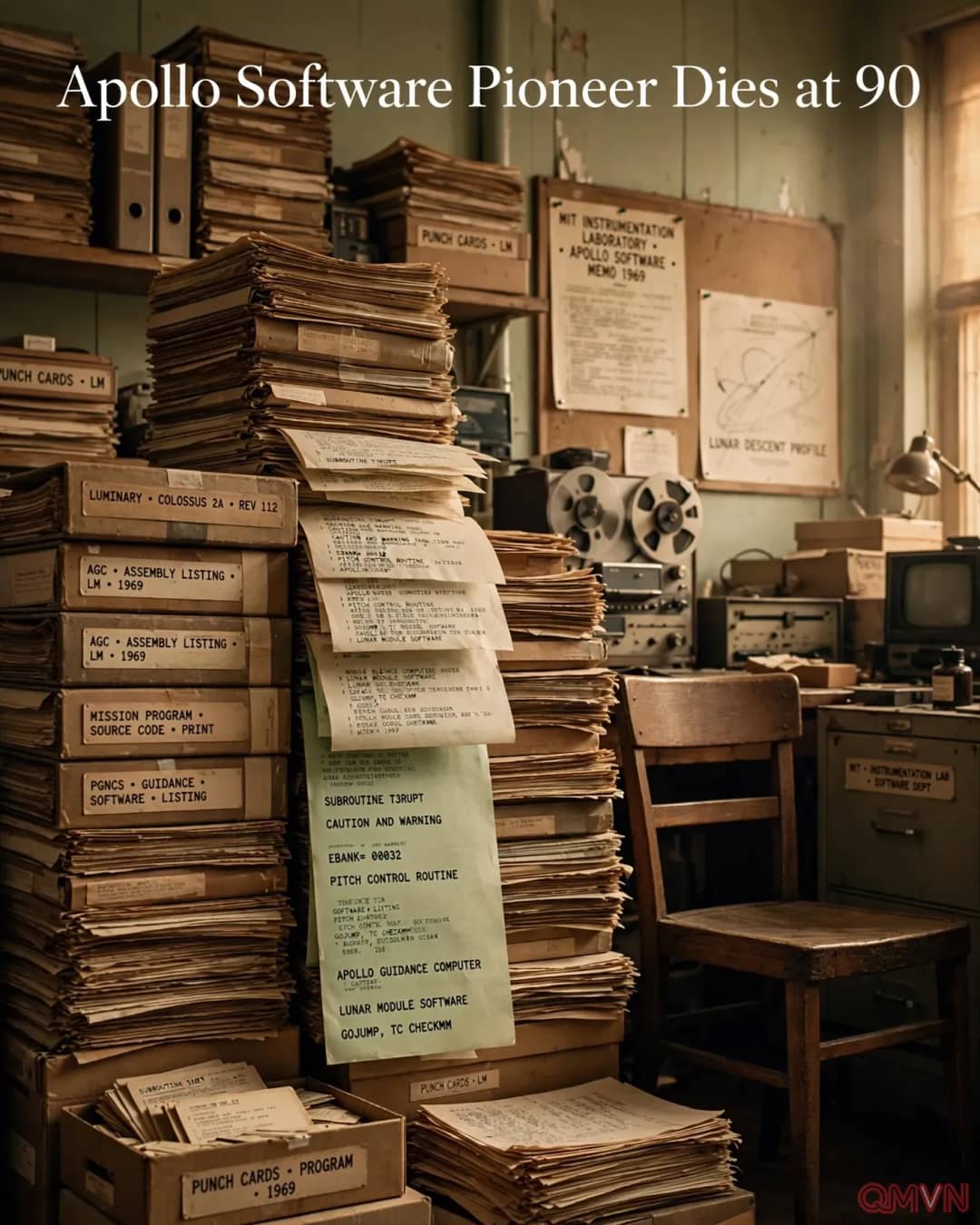
Hamilton is credited with helping popularise the term "software engineering," to establish that writing software is a serious engineering discipline like any other. A photograph of her standing beside a stack of Apollo code printouts as tall as herself has become an iconic image, inspiring generations of women to pursue science and technology.
"Looking back, we were the luckiest people in the world; there was no choice but to be pioneers." — Margaret Hamilton
Her death closes the life of a living witness to the golden age of space exploration, just as the United States prepares to send humans back to the Moon.