A rebound that could not hold
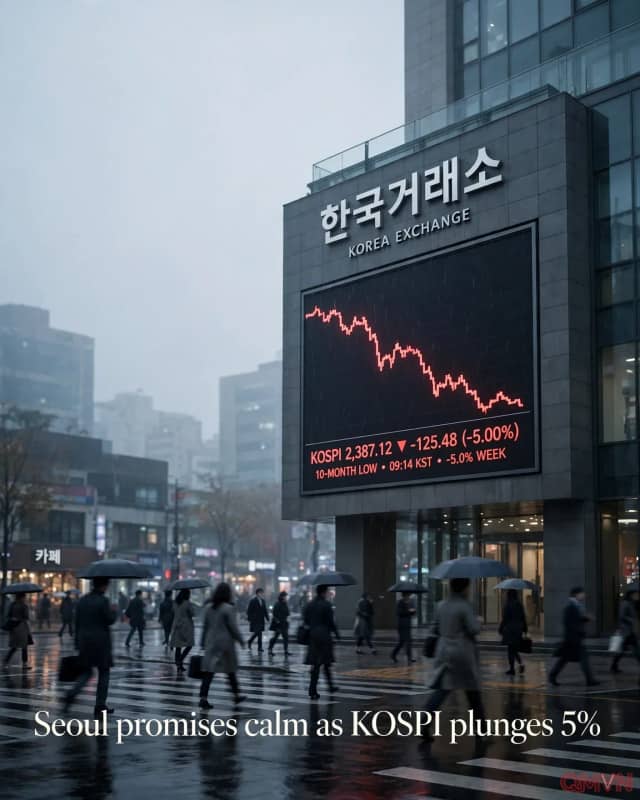
Tuesday's 6.32% advance followed Jensen Huang's return to Nvidia's leadership, but the relief proved fleeting. Korea Exchange figures reported by Seoul Economic Daily put Wednesday's closing loss at 308.52 points. A sharp overnight decline in American semiconductor shares and renewed concerns about US trade policy provided additional reasons for investors to reduce exposure. The exchange temporarily suspended program sell orders through its sidecar mechanism, illustrating the intensity of trading rather than resolving the underlying uncertainty.
The Korea Herald traced the downturn to several successive changes in expectations: initial anxiety about investment returns and interest rates in the summer, renewed revenue concerns in October, and additional regulatory and financing uncertainty in November. These pressures have reinforced one another. Higher financing costs can reduce the appeal of projects whose revenues lie years in the future, while weaker confidence in those revenues makes lenders and shareholders less willing to fund expansion. A market that had priced in sustained growth must adjust when those assumptions become less secure.
When diversification becomes an illusion
The central vulnerability is the composition of the benchmark. Samsung Electronics and SK hynix represented approximately half its capitalization as of November 20, according to The Korea Herald.
An investor holding a broad Korean index therefore has considerable indirect exposure to memory chips and the global AI investment cycle. The effect extends beyond the two manufacturers: suppliers of equipment, components and materials can face similar changes in expectations when customers reconsider expansion plans.
Reported correlations among Kospi 200 stocks rose markedly in October, reaching an average of 0.67 compared with a historical figure of 0.2. Correlation is not a measure of whether individual businesses are healthy; it indicates how closely their returns move together. When it increases, owning many different shares may provide less protection against a common shock. In such conditions, portfolio risk depends on the underlying economic exposures, not merely the number of companies held.
Foreign capital and the financing question
The Korea Herald reported overseas net selling of more than 220 trillion won in Korean main-market shares during the year. MoneyToday reported another 1.91 trillion won in net foreign selling on November 25. Such withdrawals can intensify price movements, especially when fewer buyers are willing to absorb large orders. They do not, by themselves, establish that the country's productive capacity has deteriorated. International investors may also be reducing risk across markets or reallocating assets in response to changes in interest rates and financing conditions.
The AI industry faces a related challenge. Data centers need substantial capital before their eventual revenues are clear, and some providers depend heavily on borrowing. The Korea Herald pointed to concerns over financing relationships between Nvidia and its customers, including elevated bond yields at CoreWeave in October. For Korean memory manufacturers, the important issue is whether customers can continue purchasing equipment at the pace incorporated into earnings estimates. A slower investment cycle would not necessarily mean AI technology has failed, but it could materially alter the profitability of its suppliers.
Cheap shares are not a guarantee
The contrast between share prices and earnings forecasts is striking. The reference report puts the rise in expected earnings per share over the next twelve months at 35.7% from the June peak through November 20, even as the index lost approximately 47%. Its forward price-to-earnings multiple consequently fell to just above three. A low multiple may reflect an attractive price relative to anticipated profits, but it may also signal that the market doubts those profits will persist.
A durable recovery would require more than a temporary improvement in sentiment surrounding an individual technology executive. Investors will be watching whether AI customers convert spending into revenue, whether chipmakers can sustain margins and whether financing conditions stabilize. Broader participation across industries would also reduce the dependence of market performance on a handful of companies. None of these developments is guaranteed, and a rebound in the index alone would not establish that the underlying concerns have disappeared.