Criticism from Tokyo
In July, Hideki Makihara, a former Japanese justice minister who had been involved in the project, wrote on X that what stood out in negotiations was the repeated recklessness of the Indian side. He said India kept reversing commitments and pursuing its own interests to the very end, insisting the delay was entirely New Delhi’s fault.
They just don’t keep promises, no matter what.
India’s foreign ministry spokesperson, Randhir Jaiswal, rejected the remarks as a personal opinion at odds with the facts and said talks between the two countries were going well. In September, a senior Japanese official told The Hindu that progress had not met Tokyo’s initial expectations, but that work was now moving at a steady pace.
A decade without a passenger
In 2015, the two countries agreed to build the Mumbai–Ahmedabad line, backed by a concessional loan from the Japan International Cooperation Agency (JICA) covering about 81% of the original estimated cost, at 0.1% interest over 50 years. The project was a centerpiece of Prime Minister Narendra Modi’s drive to modernize India’s railways. Its path, however, has been bumpy:
- The original completion target of 2022 was missed because of lengthy land acquisition and the Covid-19 pandemic.
- The estimated cost has risen from about Rs 1.08 trillion to about Rs 1.98 trillion.
- The first priority stretch is now expected to begin operating in 2027.
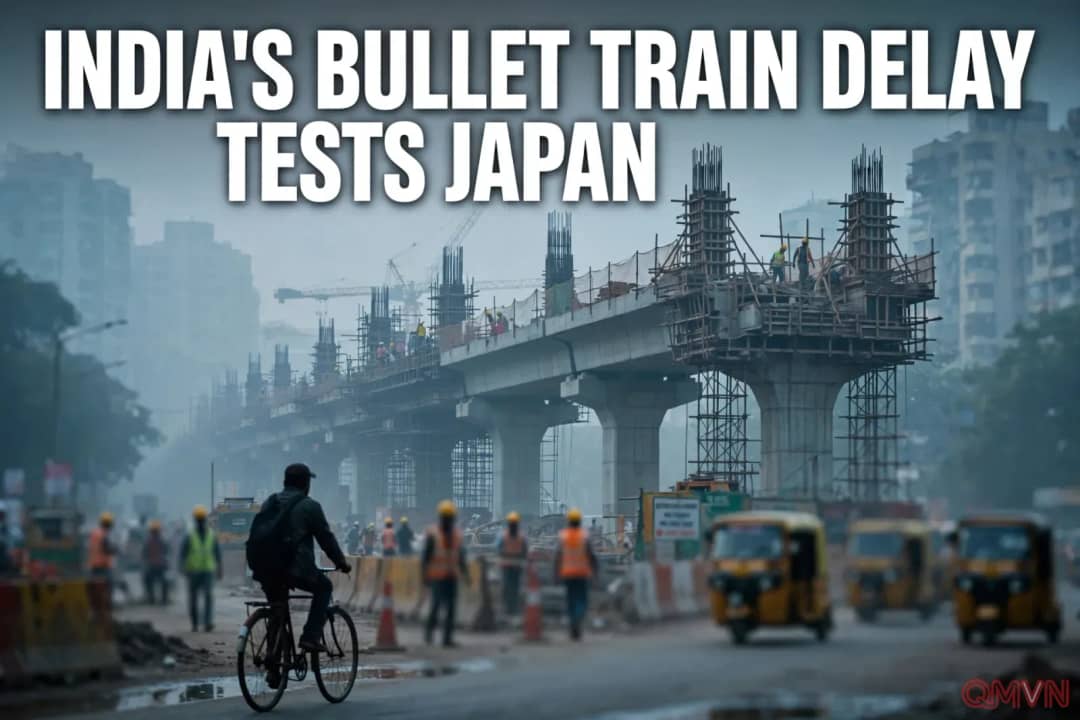
Large sections of elevated track have now taken shape, and the government says all the necessary land has been acquired. Masafumi Shukuri, head of the International High-Speed Rail Association, argues the delays should be seen in light of the project’s scale: even Japan, with more than 60 years of experience, would struggle to complete a 500km line in 10 years.
Disagreement over technology
Under the original plan, Japan was to supply three main components: Shinkansen trains, the signalling system and the operation control center, while India handled civil construction. Japanese advocates argue that the Shinkansen works as an integrated system in which trains, signalling and operating procedures are designed together, and that this is key to its safety and punctuality.
However, Japan’s next-generation E10 Shinkansen is still in development and is expected only in the early 2030s, or not before 2034 according to an Indian official. In 2024, New Delhi decided not to wait and to start services with domestically built trains. State-owned BEML and the Integral Coach Factory are building trainsets with a top speed of 280km/h, below the planned 320km/h, under the “Make in India” and “Self-Reliant India” initiatives.
The signalling dispute
The most contentious issue is signalling. According to the Financial Times, India’s decision to award a key signalling contract to Germany’s Siemens dismayed Japanese companies led by JR East. India has moved to the European Train Control System (ETCS), an open standard used, with variations, in South Korea, Taiwan, China and Europe.
Japan worries that combining Japanese infrastructure with European signalling and Indian trains is a configuration never tested as an integrated system. India says the equipment was ordered to international specifications, and Jaiswal has said New Delhi received no Japanese offer for the signalling system.
A relationship sturdier than the rails
The stakes go well beyond the Mumbai–Ahmedabad line. India has identified seven future high-speed corridors totaling nearly 4,000km, with expected investment of about Rs 16 trillion. The first line could become the template for the whole network. For India, flexibility in technology is tied to building a domestic industry; for Japan, preserving the integrity of its system and the role of its companies is central.
Still, neither government wants the dispute to derail the wider relationship. At a summit in New Delhi in July, Japanese Prime Minister Sanae Takaichi said the two countries should develop ties “as brother and sister.” Their joint statement reaffirmed the project as a flagship of cooperation, said Japan understood India’s 2027 target and expressed willingness to cooperate on a national high-speed network of 7,000km. One Indian diplomat remarked that bilateral ties are moving faster than the bullet train itself.