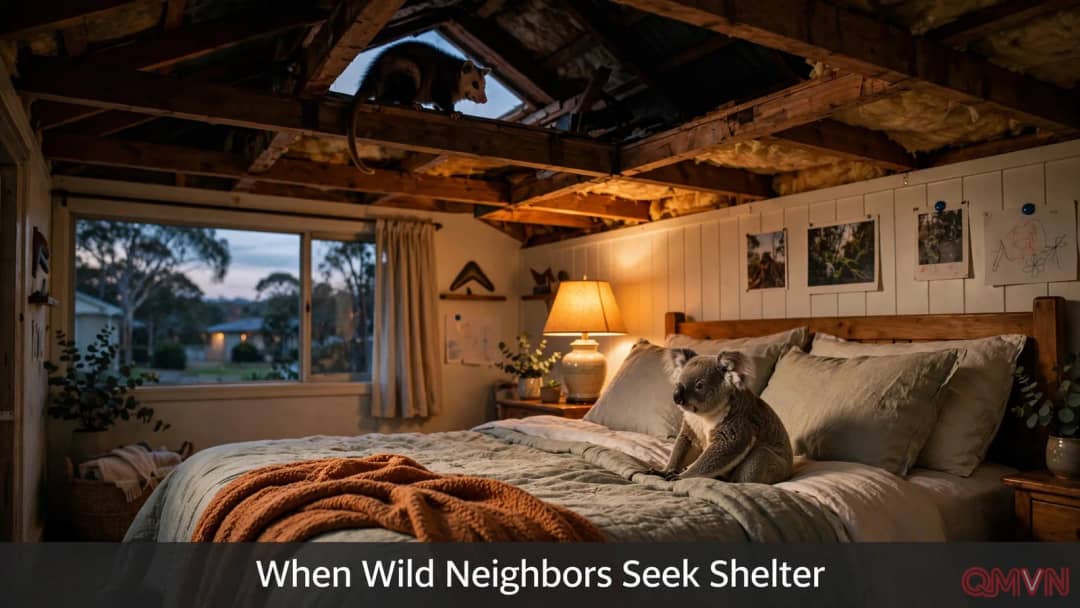
When Our House Becomes Their House
Researchers led by architect Bethany Kiss from the University of Melbourne worked with data from Wildlife Victoria and Wires. Kiss said we found native wildlife using almost every part of the house imaginable. People often think these are unusual incidents, but they are actually very common. Interior roofs topped the list, followed by garages and sheds, under the house, roller doors, wall cavities, exterior roofs, heating ventilation and cooling systems, balconies, general living spaces, mailboxes, doors, outdoor living spaces, chimneys and windows.
The stories make numbers vivid. One caller to Wildlife Victoria emergency service discovered juvenile sugar gliders in her kitchen. She had reached under the sink for a dishwashing tablet and instead her hand landed on something furry. Investigating further, they found two gliders curled up together in a small jar. When a volunteer was dispatched, they found five more.
Another case, an echidna found its way into a house and headed straight for the pantry. The homeowner found him pulling items off the shelves, including a heavy food processor. Luckily, the homeowner was also a wildlife rescuer and was able to safely return it outside. While renovating, a homeowner found eight little forest bats roosting in a wall. Ericka Tudhope, a rehabilitation specialist from Microbats of Melbourne, said bats living in the roof was common and nothing to be concerned about so long as people left them alone. They make great housemates by keeping bug numbers down and rarely do any damage.
Why They Knock On Our Doors
The deeper cause is habitat loss and loss of tree hollows. When forests are cleared for housing estates, mines, agriculture and industrial logging, possums, gliders, carpet pythons and many other species are either killed or lose their homes.
Wildcare Australia shared a photo of a koala with no home left after clearing, and Karen Scott told Brisbane Times that until you see a photo like that, you do not realize that a koala, which is supposed to be an iconic Australian species, has no home left.
Consequences go beyond shelter. Many animals weakened by drought have been succumbing to chlamydia and have been left sterile, as koala surveys show. Meanwhile, housing development on the fringes of Australian cities is destroying hectares of habitats needed for endangered animals. The Australian Conservation Foundation said its research showed the federal government had approved the clearing of more than 25,000 hectares of koala habitat since the species was declared vulnerable a decade ago.
Animals also seek shelter during cold or extreme weather, as Wires reports. When forest canopies no longer keep warm, a human roof becomes the last resort. This is not invasion but desperate adaptation.
Redesigning Homes For Both Species
Architect Bethany Kiss stressed we are in a biodiversity crisis and a housing crisis. While architecture often focuses on ways to keep nature out, there are opportunities to design buildings that are better for both people and wildlife. In the United Kingdom buildings are being intentionally designed for habitat, such as the requirement to include swift nesting bricks in new builds. In Australia, she would like to see ecologists embedded in the design process like you would with an engineer.
Solutions could include wildlife-friendly lighting and noise reduction measures, as well as habitat features like swallow shelves or possum boxes, and retaining hollow trees. Prof Sarah Bekessy, co-author and Biodiversity Council lead councillor, said research consistently showed that people benefited from everyday interactions with wildlife. Wildlife in our neighbourhoods can improve our mental wellbeing, strengthen people connection with nature and make cities healthier, more resilient places to live.
Wildlife Victoria advocated for peaceful coexistence where possible, but anyone concerned about an animal in their home was encouraged to contact local wildlife rescue. The humane message is that every house can be a shared house, where humans learn to share space with wild neighbors who were here long before us.