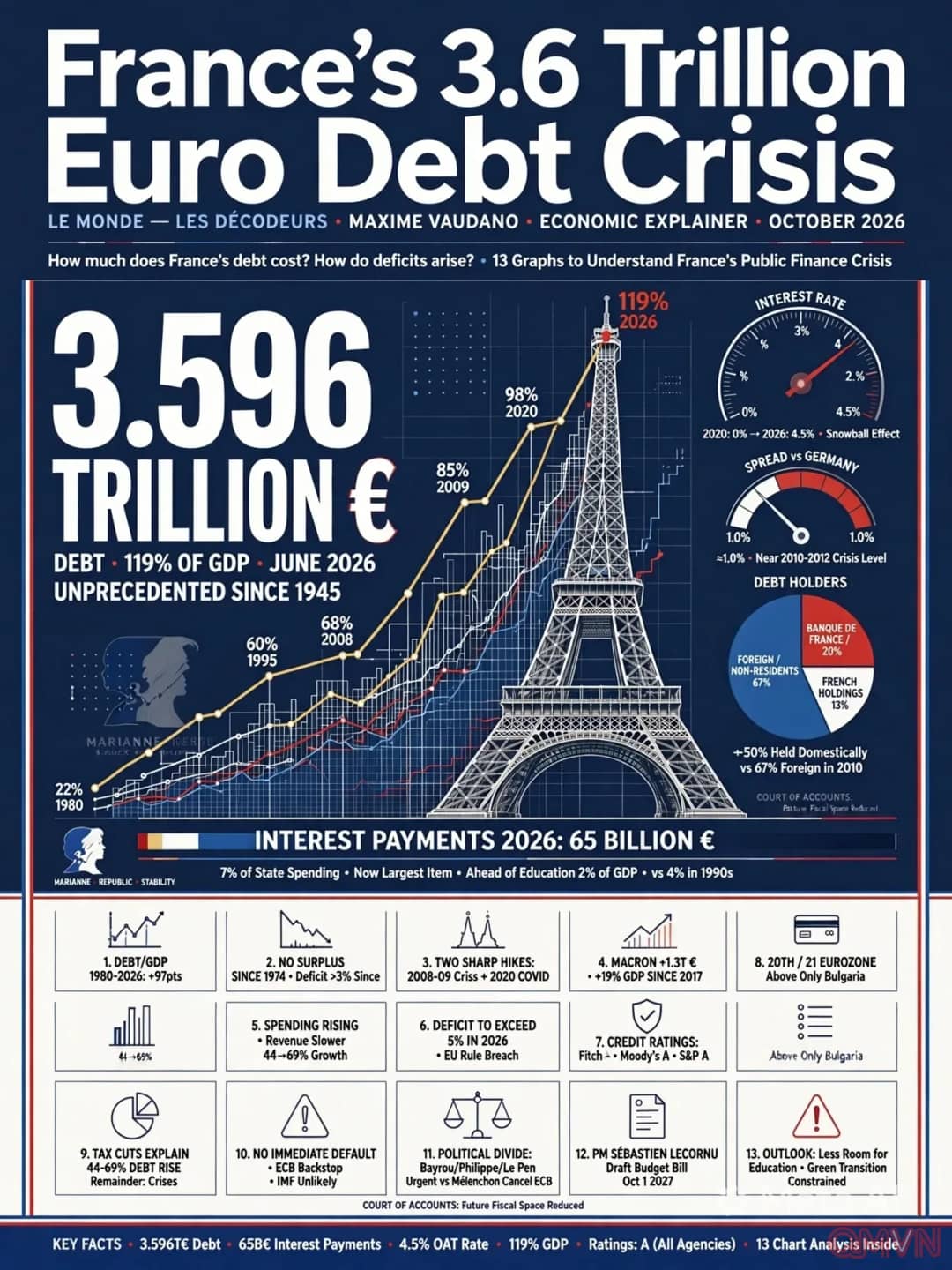
A debt unprecedented in modern times
According to the latest figures, up to June 2026, France's public debt, which covers the state, local authorities and the social security system, stands at €3.596 trillion, or 119% of GDP. Although debt exceeded 300% of GDP during the two world wars, France has not experienced such a situation since 1945.
After stabilising at a low level, debt began rising sharply in the 1990s, then surged after the 2008-2009 financial crisis and the Covid-19 pandemic in 2020, when it crossed the symbolic 100% of GDP threshold. Since President Emmanuel Macron took office in 2017, total debt has risen by €1.3 trillion, equivalent to 19% of GDP.
Half a century of continuous deficits
France has not had a budget surplus since 1974 and has rarely kept its deficit below the 3% of GDP required by European Union rules. In 2026, the deficit is expected to exceed 5% again. The clearest long-term trend is public spending rising steadily and jumping during each crisis, while tax revenue has grown much more slowly.
According to a 2024 study by the French Economic Observatory (OFCE), during the first seven years of Macron's presidency, 44% to 69% of the debt increase came from crises. The rest is explained by tax cuts for households and businesses, which cost the treasury significant revenue.