MAIN CONTENT
A trading session that changed the mood
At the New York close, the Dow Jones Industrial Average stood at 48,147.33, down 949.73 points. The S&P 500 lost 265.41 points to 6,910.42, while the Nasdaq Composite surrendered 1,261.47 points to finish at 22,617.73. Reuters reported that the S&P 500 had fallen for seven consecutive sessions, its longest losing sequence since February 2020. The Nasdaq also surrendered its gains for the year. What began as anxiety over expensive technology shares had become a far wider reassessment of risk.
A market correction conventionally means a decline of at least 10% from a recent peak; it is not a declaration that the economy is in recession. Yet seeing both the Dow and S&P 500 cross that threshold carried psychological weight. The VIX volatility index reached its highest closing level since April 2025, while declining stocks vastly outnumbered rising ones on both major US exchanges. Total volume reached 25.19 billion shares, against a 20-session average of 19.50 billion, suggesting investors were making substantial portfolio changes rather than quietly sitting out the turmoil.
Why Anthropic and Nvidia failed to restore confidence
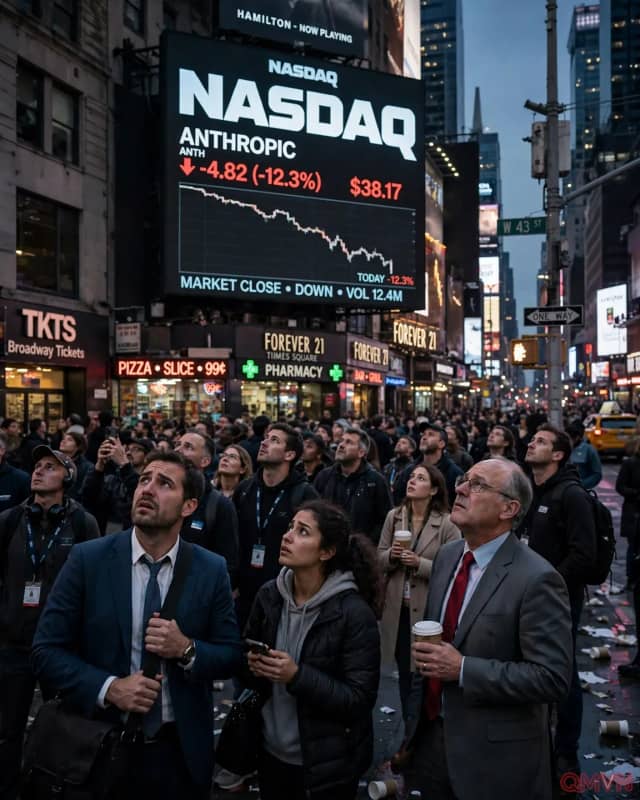
Anthropic's November 19 market debut had been viewed as a landmark test of enthusiasm for the artificial-intelligence industry. Shares were offered at $83 and finished their first day 17.1% above that price, evidence of considerable initial demand.
But the excitement faded quickly; Reuters reported a fall of around 9.1% on November 20. Investors increasingly wanted more than impressive AI systems and rapidly growing usage. They wanted convincing answers about how revenue and eventual cash generation would cover immense spending on computing infrastructure.
Nvidia, a central supplier of AI computing equipment, plunged 13.8% despite quarterly results widely regarded as exceptionally strong. Horizon Investment Services chief executive Chuck Carlson said Nvidia had delivered outstanding results, yet Anthropic's offering had failed to become the sentiment-resetting event many expected. The episode illustrates a demanding market reality: excellent earnings may not be enough when valuations already assume years of extraordinary growth. The Philadelphia semiconductor index, up more than 100% year to date at one point in mid-June, had seen its annual gain shrink to approximately 18.7%.
The selloff spreads beyond technology
The retreat reached across the AI investment chain. Amazon fell 3.9% and Meta lost 5.9%, while specialist cloud-infrastructure providers CoreWeave and Nebius declined 12.1% and 16.1% respectively. Caterpillar, whose power-generation and backup-power products can serve data-center infrastructure, dropped 5% amid concerns that demand might weaken. A slowdown in anticipated AI spending can therefore affect companies far removed from model development: equipment vendors, electricity suppliers and construction businesses are tied to the same capital-investment cycle.
The defensive mood also reached cryptocurrencies. Bitcoin slipped below $60,000 at one point, while shares of Coinbase, Strategy and Robinhood fell between 6.3% and 9.6%. Elsewhere, Intuit dropped 12.8% after reducing its revenue-growth outlook and agreeing to sell Mailchimp to Bending Spoons for roughly $3.68 billion. UnitedHealth provided an exception, gaining 2.8% after TD Cowen upgraded the stock. That divergence matters: even during broad selling, company-specific fundamentals can still influence where money moves.
Inflation and interest rates become the next test
Valuations for fast-growing businesses are especially sensitive to financing costs. Federal Reserve Governor Lisa Cook said the central bank's policy rate was not high enough to address prevailing inflation. According to Reuters' account of CME Group's FedWatch pricing, traders were assigning an almost certain probability to a quarter-percentage-point Fed rate increase in December. Higher rates raise the cost of borrowing and reduce the present value of profits that investors expect to receive many years in the future, a particularly important consideration for capital-intensive AI ventures.
The forthcoming personal consumption expenditures inflation figures will provide another indication of the Fed's likely course. Bill Northey of U.S. Bank Wealth Management argued that market sentiment was overpowering fundamentals in the immediate term even though economic activity and corporate earnings retained strengths. The decline therefore cannot, by itself, prove that artificial intelligence is a failed investment theme. It does, however, shift the conversation from technological possibility to financial discipline: actual customers, durable margins, funding needs and the years required to earn back infrastructure costs.