A finding that challenges old assumptions
According to the South China Morning Post, the study, with associate professor Shen Jingyi of Shandong University’s school of archaeology as corresponding author, was published on October 13 in the peer-reviewed Journal of Cultural Heritage.
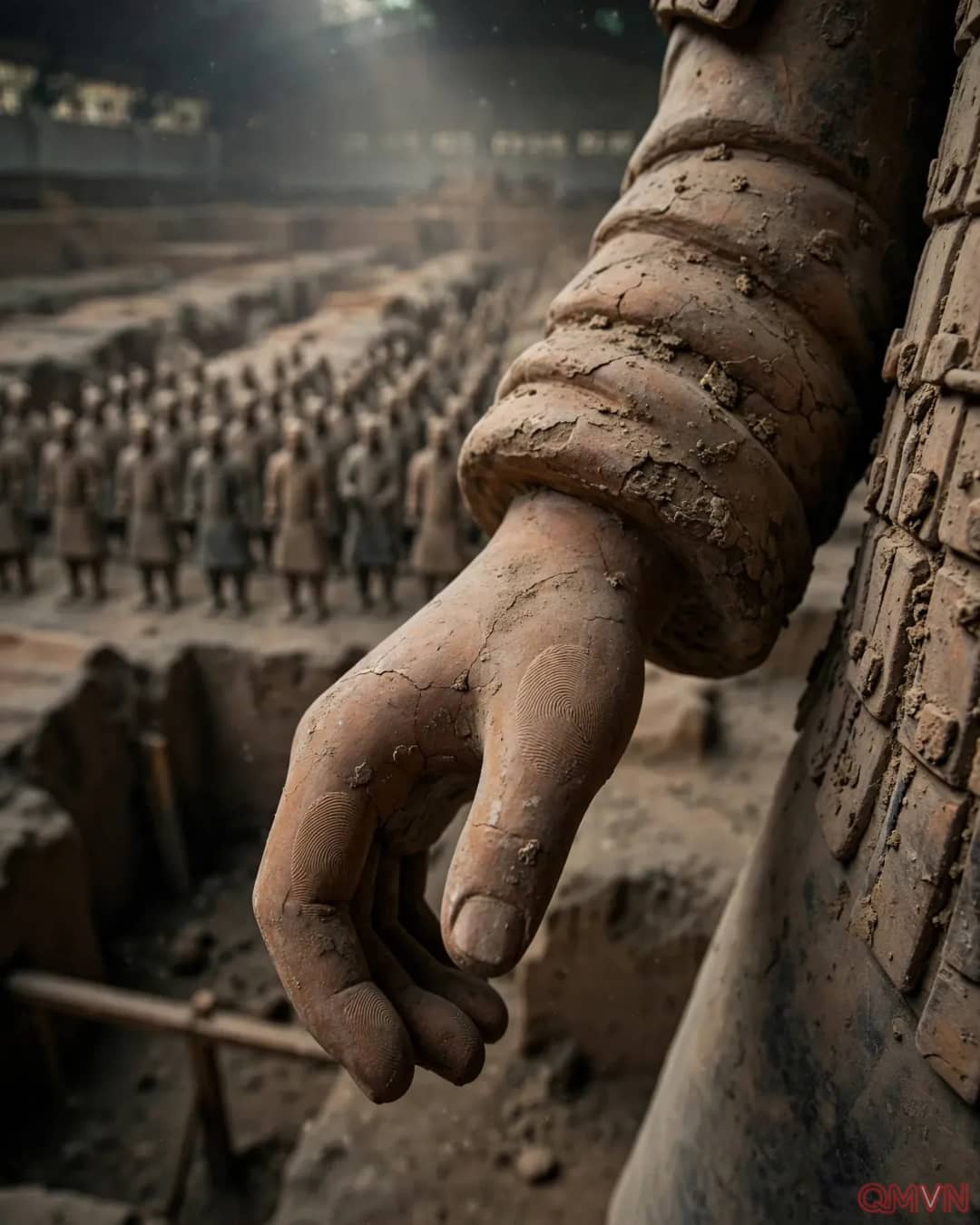
These findings challenge the long-held assumption that Terracotta Army production relied exclusively on adult male labour, providing the first quantitative biological evidence for a diverse workforce including women and children.
The team’s model provides estimates of who left the fingerprints:
- Men accounted for about 45% of all fingerprints.
- Women accounted for nearly 32.7%.
- Children under 15, the legal threshold of adulthood under Qin law, accounted for about 22.3%.
How the study was done
The researchers analysed 79 well-preserved fingerprints on 36 warrior figures in Unit T23 of Pit 1 of the First Qin Emperor’s mausoleum. Rather than trying to classify each trace, they used a Bayesian mixture model to analyse the whole group of prints at once, and compared them with modern fingerprint data across ages and sexes. They measured mean ridge breadth, which increases with age.