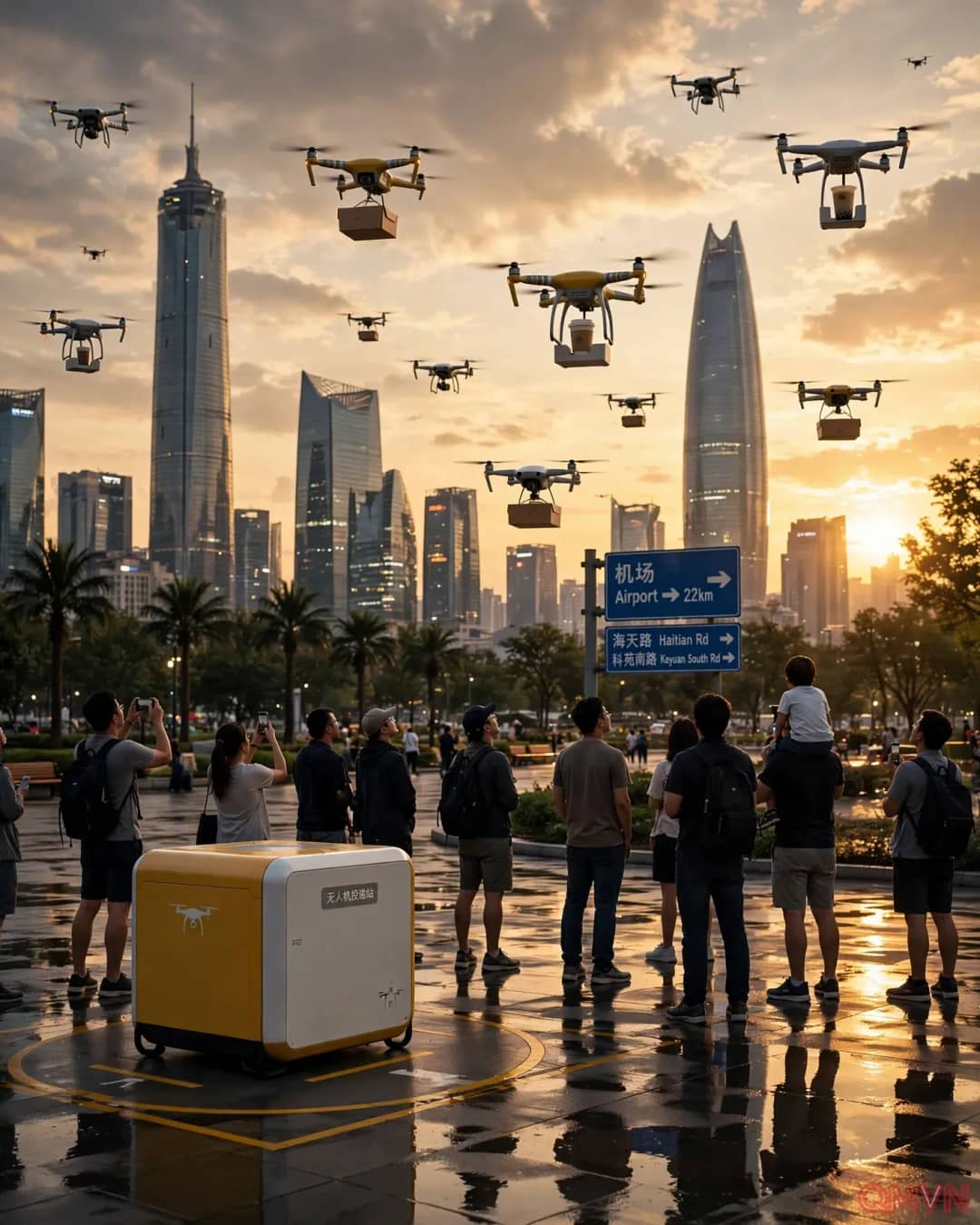
Busy Skies Over Shenzhen
Tourists simply scan a QR code to order food, coffee or bubble tea, and drones fly the orders to parks or scenic spots. For many foreign visitors, it is a novel experience. Liew Kee Ho, a visitor from Southeast Asia, said anything you have never tried before feels exciting the first time.
Back in Malaysia, I’ve never seen drones used to deliver milk tea or food.
Another visitor, 40-year-old Qin Pei, said drone delivery is quite necessary in places like parks, where food delivery drivers often struggle to find customers.
This set-up is also particularly well-suited for the kind of extreme heat we see in China.
China Leads in Drone Logistics
The “low-altitude economy” refers to activity in airspace up to about 1,000 meters. According to China’s civil aviation authorities, the numbers show the sector’s boom:
- By the end of 2025, China had 3.29 million registered drones.
- Annual drone flight hours rose nearly 70% in 2025, to 45.3 million.
- Operators such as Meituan have set up regular routes for hundreds of thousands of deliveries.
- The service is available in Beijing, Shanghai, Shenzhen and even at the Great Wall.
Such a level of commercial deployment is rare in most other countries, made possible by China’s world-leading drone manufacturing base and strong government support.
A Pause for the APEC Summit
In Shenzhen at least, however, this convenience will briefly disappear during the summit. Meituan said it suspended drone deliveries in the city for 10 days from November 11 at the request of regulators and has not set a date to resume. Routes in other cities are unaffected.
The APEC Economic Leaders’ Meeting in Shenzhen on November 18-19 is expected to bring together many heads of state, including Chinese President Xi Jinping and US President Donald Trump. The suspension highlights the challenge of balancing technological innovation with security requirements in managing low-altitude airspace.